Nasal irrigation and CRS: which is the best device? Cadaver study

The results of the study conducted by the research group composed of Drs. F. Mozzanica, F. Collurà, A. Preti and F. Ottaviani from the Department of Clinical and Community Science ,San Giuseppe Hospital, University of Milan, on the efficacy of different nasal irrigation medical devices before and after surgery for Chronic Rhinosinusitis(CRS) were presented at the World Congress of Nasal Endoscopy 2018.
EPOS Guidelines and Nasal Irrigation
EPOS guidelines tell us that the main-and most recommended-therapy for patients with Chronic Rhinosinusitis (CRS) is the following nasal irrigations with saline solution and topical sprays. Meta-analyses show that nasal washes have a positive effect in patients both before and after surgery.
Nasal irrigation
The nasal lavage is now an established therapy and a very useful tool in the treatment of chronic rhinosinusitis. The practice ofadding medications within nasal washes to increase their distribution has also become widespread. Specifically, the medical nasal irrigation devices with the best results are those that are with high volume and low pressure.
There are many medical devices fornasal irrigation on the market and many of these medical devices have been studied to determine the best technique for reaching the regions involved by CRS; high volume nasal irrigation medical devices have been shown to be more effective than sprays and nasal drops.
Recent studies have also shown that high volume nasal irrigations have significantly better irrigation penetration into the sinuses, especially in post ESS(endoscopic sinus surgery) cavities, than low volume irrigation methods such as sprays.
Topical steroids
As for the topical steroids, there is certainly an indication for long-term maintenance of therapy, and they are always recommended in the postoperative period, both in patients with chronic rhinosinusitis and in those without. Topical nasal steroids are usually prescribed long-term because in these patients they counteract the underlying inflammatory disorder, and avoid the potentially adverse effects of systemic steroids.
However, adequate intranasal delivery of topical corticosteroids continues to be one of the greatest obstacles in decreasing sinus mucosal inflammation.
Some authors have begun to doubt the rule that the best way to administer steroid is by nasal spray.
Following endoscopic sinus surgery, irrigation has been shown to be effective in ameliorating edema, and removing crusts and secretions. There is evidence, however, that steroid penetration beyond the nasal cavity and into the sinuses is limited.
Other authors have hypothesized that the addition of a topical steroid within a nasal wash allows for both positive effects in the lintel of therapy (nasal lavage + topical steroid), with the added possibility of having better diffusion within the sinuses than with a nasal spray.
The study
Thus, the purpose of this study is to answer the question: what is the best technique for sinusirrigation?
Since the efficacy of some devices has already been demonstrated, they could be used for the administration of topical steroids within the sinuses. It was therefore aimed to compare the distribution of irrigation in the sin uses in different levels of SSE, according to different nasal irrigation techniques. In particular,syringe, pressure bottle, gravity drop and nebulizednasal irrigation were analyzed.
Materials and methods
The study, in its preliminary stage, involved the use of 2 cadaver heads. Each was analyzed through 3 different approaches so that the inside of the sinuses could be observed.
First, the supracanine approach was used to observe the frontal sinuses using a 0° endoscope, followed by the supracanine approach for the maxillary sinuses. Finally, the team conducted a craniotomy with removal of the encephalon, and drilling of the sphenoid sinus into the upper wall to allow direct observation.
Once the heads were prepared, 6 different medical devices were used to compare the efficacy of nasal irrigation: 2 pressure irrigation devices, 2 gravity and low-pressure drop devices(Nasir), a common needleless syringe, and a nebulizer device. Irrigation is performed with a dyed solution (methylene blue) and with the head position tilted 45° downward.
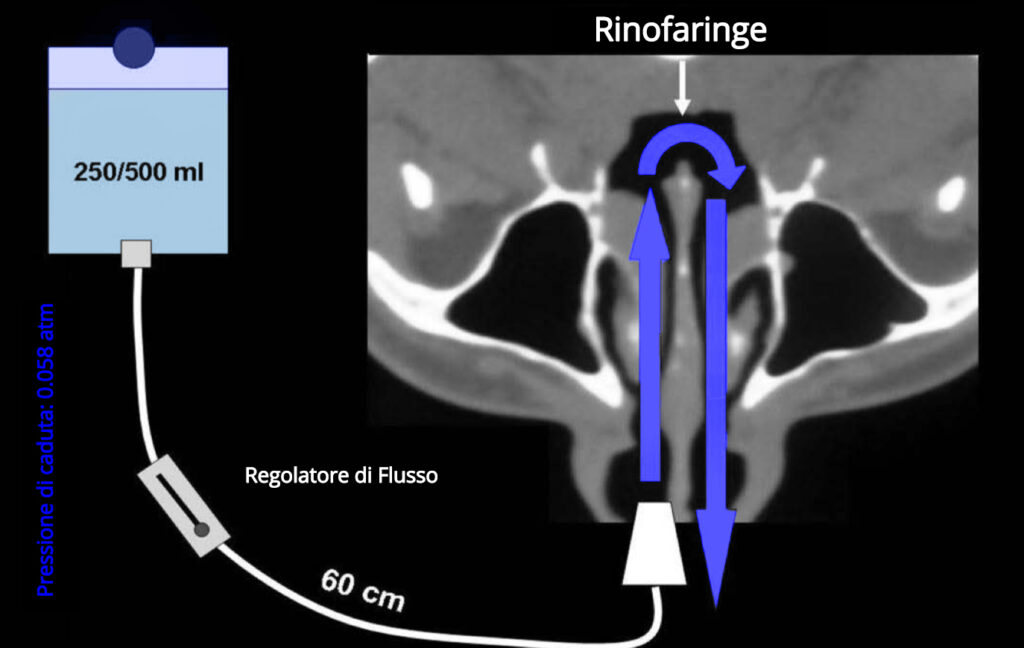
The amount of irrigating solution within each breast was then recorded by assigning a semi-quantitative score: 1. No irrigation, 2. Bubbles/foam on the hosts, 3. Dripping through the hosts, 4. Free flow.
Approaches to dissection
The researchers tested the 6 devices with 4 different approaches. The first approach corresponds to observation without dissection(no surgery), in the second to a level 1 FESS (functional endoscopic sinus surgery)(uncinectomy, Draf 1, sphenoid recess enlargement), in the third to a level 2 FESS (antrostomy, Draf 2 A/B and sphenoidotomy, while the fourth approach is a level 3 FESS (extended antrostomy, Draf 3 and orbit-wide sphenoidotomy).
Results and discussion
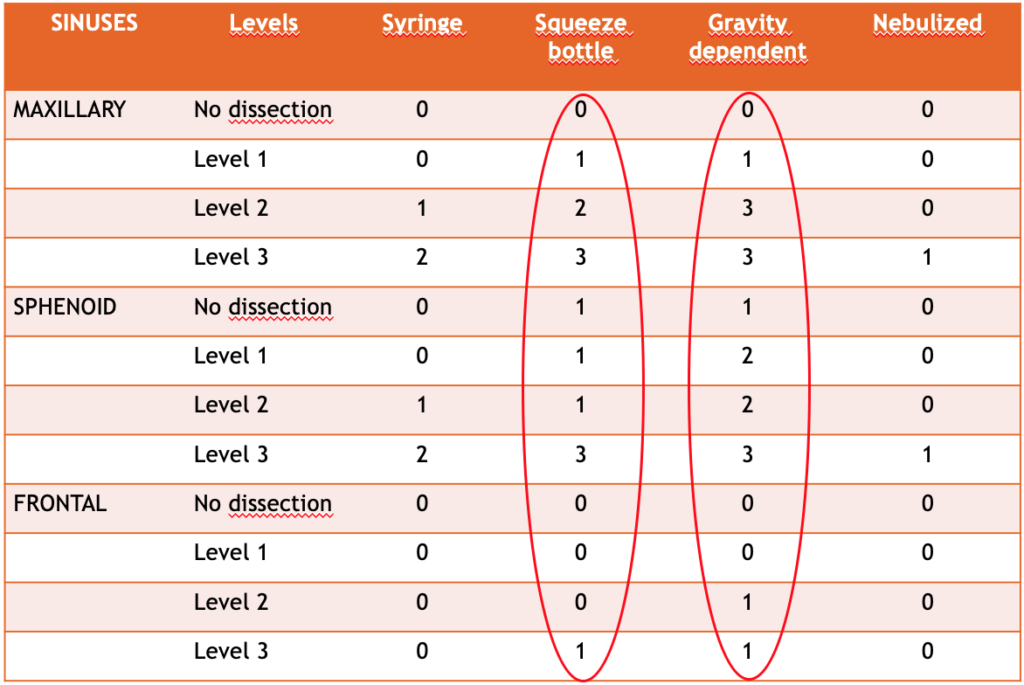
The study thus highlighted that:
- The most effective nasal irrigations are those performed with gravity drop devices and pressure bottles.
- Nebulizer devices are the worst at distributing solution in irrigation.
- Irrigation of the frontal sinuses is difficult with all available devices.
- Further investigation of the role of head position is needed.
- Medical devices for gravity drop nasal irrigation are more effective than pressure bottles.
Thus, it is possible to say that high-volume, low-pressure nasal irrigation (nasal lavage) medical devices can enable better administration of drugs and solutions within the sinuses.
F. Mozzanica, F. Collurà, A. Preti, F.Ottaviani, Department of Clinical and Community Sciences, San Giuseppe Hospital, University of Milan, Milan, Italy
November 29-30, 2018
Bibliography
Harvey R, Hannan SA, Badia L, Scadding G. Nasal saline irrigations for the symptoms of chronic rhinosinusitis. Cochrane Database Syst Rev. 2007 Jul 18
Wormald PJ, Cain T, Oates L, et al. A comparative study of three methods of nasal irrigation. Laryngoscope 2004
Soudry E., Wang J., Vaezeafshar R. et al. (2016) Safety analysis oflong-term budesonide nasal irrigations in patients with chronic rhinosinusitis post endoscopic sinus surgery. International forum of allergy & rhinology.
Singhal D, Weitzel EK, Lin E, et al. Effect of head position and surgical dissection on sinus irrigant penetration in cadavers. Laryngoscope
transl. ita by author
Read also:
Nasal irrigation with Nasir® in children (scientific article)
- Nasal irrigations of preschool children (scientific article)
- Chronic rhinosinusitis: budesonide and nasal irrigation (scientific article)
- Snoring: new study on Nas-Air® nasal dilator (scientific article)